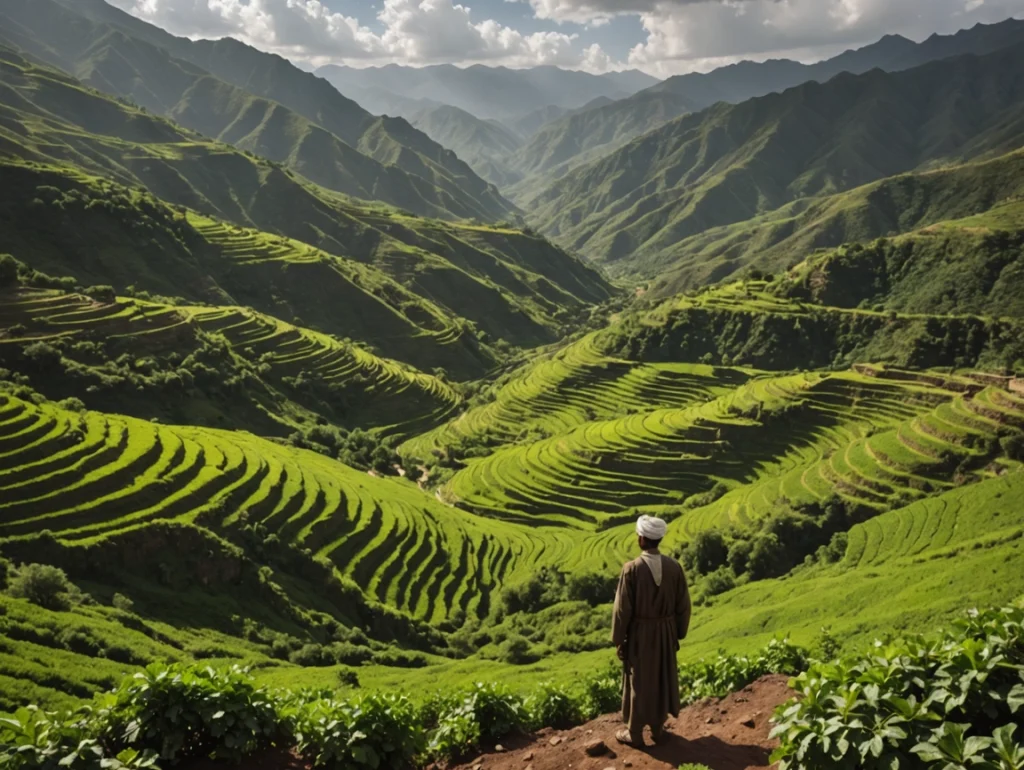
High in the mountains of Haraz, where clouds rest on peaks carved by centuries of history, lives a farmer named Hassan Al-Mahdi. His family has cultivated Yemeni coffee for more than 300 years — long before the world even knew what “specialty coffee” meant.
Hassan wakes up every morning before sunrise. He steps into terraces built by his great-grandfathers, where each stone still carries the marks of their hands. For him, coffee is not just a crop — it is a legacy.
“My coffee trees are like my children,” he says.
“They depend on me, and I depend on them.”
Unlike modern farms around the world, Hassan uses pure traditional methods:
- No chemicals
- No irrigation systems
- The coffee relies solely on mountain rainwater and natural soil minerals
- The cherries ripen slowly, giving the beans their legendary density and flavor.
- His story mirrors the story of Yemeni coffee itself — the world’s first cultivated coffee, the bean that once traveled from Mocha Port to Europe, shaping the global coffee culture.
- A Struggle That Preserves Quality
- For years, Hassan battled drought, road closures, and transportation difficulties. Many farmers quit.
- But Hassan stayed.
- One year, after losing half his crops, he told his wife:
- “If I leave the land, the land will forget me.
- But if I stay… the world will remember our coffee.”
- Today, roasters from America, Korea, and Europe compete to buy his coffee — drawn by:
- its rare fruit-forward notes,
- natural drying process,
- and the unmistakable Yemeni aroma.
- From Haraz to the World — Through Sand Coffee
- In 2024, Sand Coffee became one of the few suppliers who work directly with farmers like Hassan — ensuring:
- Fair pricing for farmers
- Consistent quality for roasters
- Authentic green Yemeni coffee for global customers
- When you buy Yemeni green coffee, you’re not just purchasing beans —
- you are helping preserve a culture, a family, and a heritage older than modern coffee itself.
- Why Yemeni Coffee Is Worth the Journey
- Yemeni coffee remains unmatched because:
- It grows naturally on untouched volcanic mountains
- It is hand-picked cherry by cherry
- It is sun-dried on rooftops
- It carries centuries of culture in each cup
- Every sip tells a story — and Hassan’s story is just one of thousands